In the ever-evolving landscape of semiconductor manufacturing, the integration of advanced robotics is not just a trend but a necessity. As the industry strives for higher precision and productivity, collaborative robots, or cobots, are emerging as game-changers.
What Are Collaborative Robots (Cobots)?
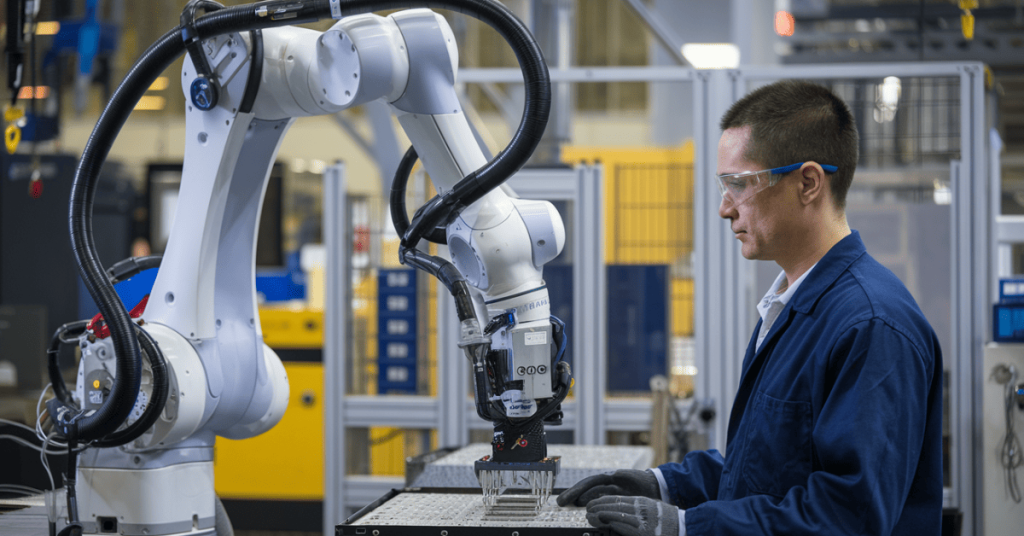
Collaborative robots, often referred to as cobots, are engineered to operate in tandem with human workers within the same environment. Unlike traditional industrial robots, which often operate in isolation due to safety concerns, cobots are equipped with advanced sensors and AI-driven algorithms that allow them to detect and avoid collisions. This makes them safe to operate in close proximity to human workers without the need for extensive safety barriers. Cobots are user-friendly, easily programmable, and can be quickly reconfigured for different tasks, making them highly versatile in various manufacturing environments.
The Role of Collaborative Robots
Unlike traditional industrial robots, which often operate in isolation due to safety concerns, cobots are designed to work alongside human operators. This collaboration enhances efficiency and precision in manufacturing processes. Cobots are equipped with advanced sensors and AI-driven algorithms that allow them to adapt to their environment and perform complex tasks with minimal human intervention.
In semiconductor manufacturing, where precision is paramount, cobots excel in tasks such as wafer handling, assembly, and inspection. Their ability to work continuously without fatigue ensures consistent quality and reduces the risk of human error. Moreover, cobots can be easily reprogrammed for different tasks, providing flexibility in a rapidly changing industry.
Enhancing Precision and Productivity
The integration of cobots in semiconductor manufacturing has led to significant improvements in both precision and productivity. For instance, cobots can handle delicate components with a level of accuracy that surpasses human capabilities. This precision is crucial in processes like photolithography, where even the slightest deviation can result in defects.
Furthermore, cobots enhance productivity by performing repetitive tasks at a faster rate than human workers. This speed, combined with their precision, allows manufacturers to increase output without compromising quality. Additionally, the use of cobots reduces the need for extensive training, as they can be programmed to perform specific tasks, allowing human workers to focus on more complex and creative aspects of production.
Trends in Automation and Robotics
The adoption of cobots is part of a broader trend towards automation in the electronics industry. As manufacturers seek to stay competitive, they are increasingly turning to advanced robotics to streamline operations and reduce costs. Here are some key trends shaping the future of automation and robotics in the industry:
- AI and Machine Learning Integration: The use of AI and machine learning in robotics is enabling more sophisticated and adaptive automation solutions. Robots can now learn from their environment and improve their performance over time, leading to greater efficiency and reduced downtime.
- IoT and Connectivity: The Internet of Things (IoT) is playing a crucial role in the evolution of robotics. Connected robots can communicate with other machines and systems, creating a seamless and integrated manufacturing environment. This connectivity allows for real-time monitoring and optimization of production processes.
- Human-Robot Collaboration: The focus is shifting from robots replacing humans to robots working alongside humans. This collaboration enhances both strengths, leading to more innovative and efficient manufacturing solutions. Cobots are at the forefront of this trend, demonstrating the potential of human-robot synergy.
- Sustainability and Energy Efficiency: As the industry becomes more conscious of its environmental impact, there is a growing emphasis on developing energy-efficient and sustainable robotic solutions. Cobots, with their ability to perform tasks with minimal energy consumption, are contributing to greener manufacturing practices.
Comparing Cobots to Traditional Robots
| Feature | Cobots | Traditional Robots |
|---|---|---|
| Safety | Safe for collaboration with humans | Requires isolation for safety |
| Flexibility | Easily reprogrammable for tasks | Fixed, task-specific programming |
| Precision | High precision, moderate speed | High speed and precision |
| Cost | Lower upfront costs, easy integration | Higher initial costs, complex setup |
| Applications | Collaborative tasks like assembly | High-volume tasks like welding |
Industries Benefiting Most from Cobots
- Automotive: Cobots are used for precise assembly, quality inspection, and handling heavy components, enhancing production efficiency and safety.
- Electronics: In electronics manufacturing, cobots handle delicate tasks such as soldering and assembly, improving precision and reducing defects.
- Food and Beverage: Cobots assist in packaging, sorting, and quality control, ensuring consistency and hygiene in food production.
- Healthcare: Cobots are used in laboratories for tasks like sample handling and analysis, increasing throughput and accuracy.
- Agriculture: Cobots help with planting, harvesting, and packaging, improving efficiency and reducing labor costs.
In conclusion, the rise of collaborative robots in semiconductor manufacturing is transforming the industry. By enhancing precision and productivity, cobots are helping manufacturers meet the demands of a rapidly evolving market. As automation and robotics continue to advance, the future of semiconductor manufacturing looks increasingly promising, with cobots leading the way toward a more efficient and innovative industry.
Are you looking to harness the power of innovation in your supply chain?
At Vyrian, we understand the critical role that precision and adaptability play in today’s fast-paced industries like semiconductor manufacturing. Just as collaborative robots optimize production processes, our algorithm-driven supply chain solutions are designed to eliminate inefficiencies and deliver unparalleled reliability.