
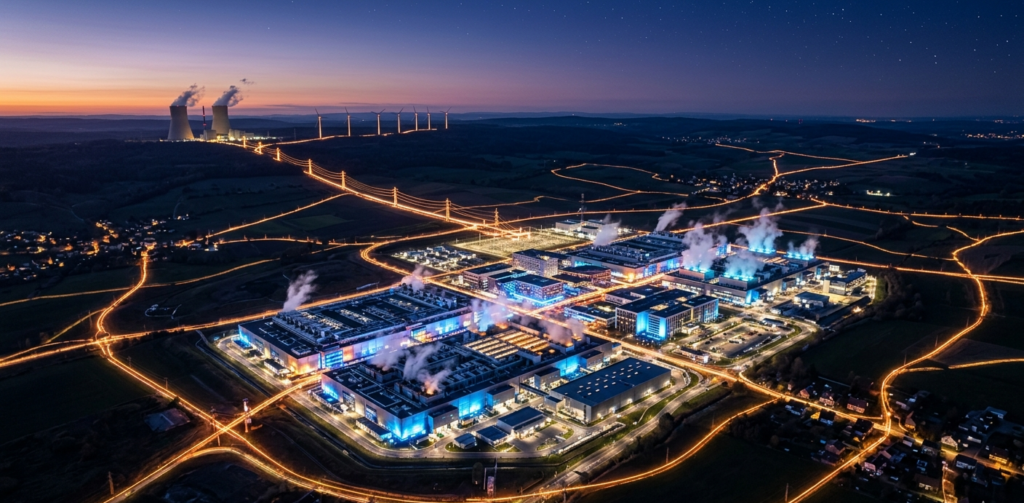
The data center industry has always consumed significant electricity. For decades, efficiency gains in server utilization and virtualization kept that consumption relatively flat. That era is over.
The rapid maturation of generative AI has fundamentally changed the energy equation. Global data centers consumed 415 terawatt-hours of electricity in 2024, roughly 1.5% of total worldwide demand. The IEA projects that figure will more than double to 945 TWh by 2030. Under high-adoption scenarios, it could reach 1,700 TWh by 2035. The infrastructure build required to support that growth is already underway and the semiconductor and sourcing decisions being made today will determine whether it succeeds.
AI Infrastructure Is Creating an Energy Demand No Grid Was Built For
The scale of AI’s energy appetite becomes clearer at the workload level. A single generative AI query consumes an estimated 2.9 watt-hours of electricity, nearly ten times the energy of a conventional web search. Multiply that across billions of daily interactions, and the cumulative load on global power infrastructure becomes structural, not incidental.
At the hardware level, the gap is equally stark. A single AI-optimized GPU rack can draw six times more power than a standard server rack, with next-generation GPU chips projected to reach 1,500 watts of thermal design power per chip by 2026. Modern GPU clusters require dramatically denser and more precise power delivery than anything traditional compute infrastructure was designed to handle.
Higher rack densities compound the challenge further. Air cooling reaches its physical limits at approximately 41 kW per rack, well below where AI deployments are headed. NVIDIA’s reference architectures for its Blackwell and Vera Rubin systems already specify direct-to-chip liquid cooling as a baseline requirement. The transition from air to liquid is no longer a design choice; it is a hardware mandate.
The grid is feeling this strain in real terms. A 35 GW energy capacity shortfall is projected in the United States alone by 2030. Microsoft currently holds an estimated $80 billion in unfulfilled Azure orders — constrained not by silicon availability, but by electricity.
Power Management ICs: The Hidden Backbone of AI Data Centers
Much of a data center’s energy efficiency depends on how effectively semiconductors convert, condition, and distribute power across the infrastructure stack. From facility-level AC/DC conversion down to point-of-load regulation at the GPU rail, the components performing that work are power management ICs — and they are under more demand than at any point in the industry’s history.
In AI server environments, PMICs regulate voltage, sequence power delivery, manage thermal load, and protect hardware operating at extreme density. Multi-phase buck controllers handle the high-current GPU rails that standard server components cannot meet. The tolerance windows are tighter, the current requirements are higher, and the thermal consequences of underperformance are immediate.
Wide-bandgap materials are accelerating this evolution. Silicon Carbide and Gallium Nitride are replacing traditional silicon in high-efficiency conversion stages because their physical properties — higher breakdown voltages, faster switching speeds, lower thermal losses — are essential at AI infrastructure power densities. GaN-based implementations are achieving over 97.5% power efficiency in high-density power supply units. Yole Group projects the power SiC market will reach $11 billion by 2031, with power GaN growing at a CAGR of 42% to 53% as data center adoption accelerates through 2027.
These components are increasingly visible on DigiKey and Mouser during the design phase. Securing them at volume, on schedule, during an infrastructure buildout of this magnitude is a different problem entirely.
From Fuel Cells to Nuclear: The Search for Scalable, Sustainable Power
Data centers are no longer passive consumers of grid electricity. Facing interconnection queues of seven to ten years and a structural capacity shortfall, hyperscalers are becoming their own utilities. By 2030, an estimated one-third of all new data center campuses will be fully off-grid.
The market has already moved. Between October 2025 and January 2026, fuel cell companies secured $7.65 billion in binding contracts to power AI infrastructure — exceeding the sector’s cumulative data center revenue from the previous decade. Bloom Energy’s stock surged 75% following a single $2.65 billion contract with American Electric Power for up to 1 gigawatt of capacity at the Cheyenne AI Factory in Wyoming. Investors read it as confirmation that alternative energy for AI had crossed from experiment to deployment.
Nuclear is following a similar trajectory. Blue Energy raised $380 million in April 2026 to advance shipyard-prefabricated nuclear plants capable of delivering up to 1.5 GW to AI data centers in Texas — with construction timelines compressed to as little as 48 months using an NRC-approved resequencing approach.
The hardware implication is direct: on-site power generation at this scale requires purpose-built power conditioning, conversion, and distribution infrastructure. Every new gigawatt of fuel cell or nuclear capacity added to a data center campus creates downstream demand for the same power semiconductors and management ICs already under supply pressure.
The Sourcing Reality Behind AI Infrastructure Growth
As AI infrastructure scales, the components enabling it are moving into allocation. As of March 2026, high-voltage PMICs carry lead times of 26 to 30 weeks — up from a standard 16-week cycle. The cause is structural: AI servers require complex multi-phase power modules consuming approximately five times the silicon area of standard server PMICs, displacing production capacity across the rest of the analog supply chain.
The underlying pressure is unlikely to self-correct quickly. Global 8-inch wafer capacity is projected to contract 2.4% year-over-year in 2026 as manufacturers prioritize high-margin AI silicon. Older foundry capacity is being decommissioned rather than retooled. That capacity is not returning.
Standard distribution channels were not built for this environment. Broadline distributors provide essential design-phase visibility, but when a critical GaN device or high-voltage PMIC goes long lead-time, resolution requires a different approach — excess inventory access, shortage management expertise, and supply chain relationships that operate outside standard allocation queues.
Counterfeit risk rises in direct proportion to allocation pressure. For procurement teams sourcing power semiconductors destined for critical AI infrastructure, verified supply chains and certified testing are not optional considerations. They are baseline requirements.
The Infrastructure Build Is Accelerating – Sourcing Strategy Needs to Match
The convergence of AI compute growth, on-site energy generation investment, and power semiconductor innovation is reshaping data center infrastructure from the utility interconnect down to the component level. Power management ICs and wide-bandgap semiconductors are no longer commodity line items. They are strategic components in a supply chain under structural pressure.
The hyperscalers committed an estimated $443 billion in infrastructure CAPEX in 2025. Forecasts for 2026 approach $690 billion. The components required to support that buildout — PMICs, GaN and SiC devices, DC-DC converters, isolated power modules — are the same ones facing extended lead times and tightening availability.
Companies that build sourcing visibility and flexibility now will be better positioned as demand continues to accelerate. Those that don’t will find themselves competing for allocated components in an increasingly constrained market.
Vyrian helps engineering and procurement teams source semiconductors, power management ICs, and data center infrastructure components — including shortage coverage and ISO-certified counterfeit testing. If you’re scaling AI infrastructure, connect with our sourcing team or search components on Vyrian.